Digital Waste Tracking for receiving sites in England
From weighbridge ticket to Waste Tracking ID, with the errors caught on the way.
Waste Relay checks each receipt against Defra's data rules. Someone with approval authority signs it off, then Waste Relay prepares it for Defra's Report receipt of waste service and keeps Defra's response with it as evidence.
For supported non-hazardous receipts at sites in England. Live submission to Defra is not switched on yet.
Listed on GOV.UK's software providers list as a self-certified provider. What that means
How it works
One receipt, from the weighbridge to the evidence.
Each step uses the names Waste Relay shows on screen. Capture, approval and submission stay separate, and nothing is sent to Defra until a person chooses to send it.
Record the load at the weighbridge.
Enter the receipt for the load: the site, the carrier, the EWC code, the weight and the disposal or recovery code. It stays a Draft while it is being completed.
Sample data
- ReceiptDraft
- DefraNot submitted
- Receipt
- RS-0142 (sample)
- Site
- Riverside Transfer Station (sample)
- Weighbridge ticket
- WB-20417
- Waste
- 20 03 01 Mixed municipal waste, 8.42 tonnes
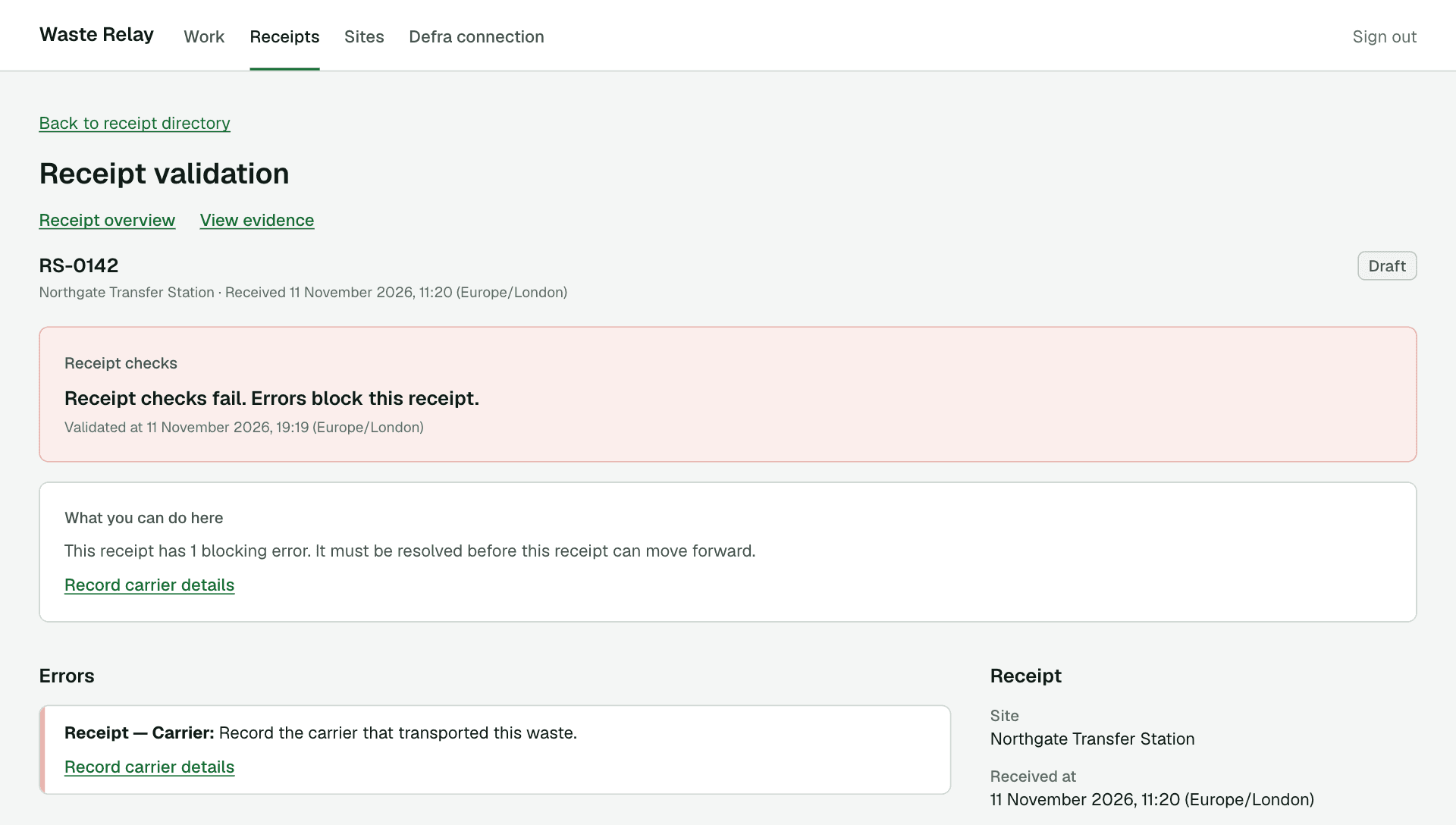
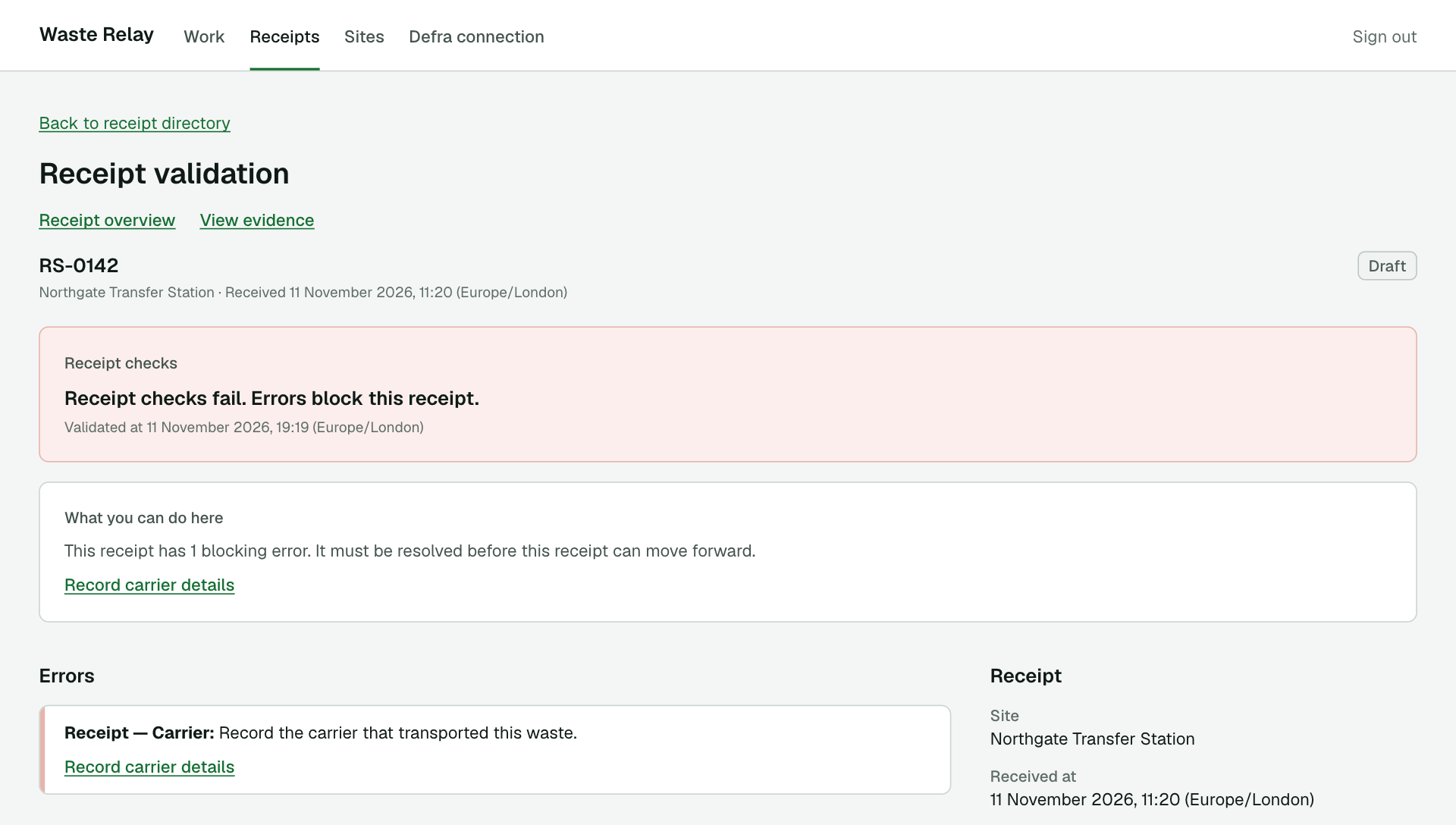
See what is missing before the vehicle leaves.
Waste Relay lists blocking errors, warnings and information findings, with a link to the field that needs fixing wherever you can edit it. A receipt with blocking errors cannot move on.
Sample data
- ReceiptDraft
- ChecksReceipt checks fail. Errors block this receipt.
- Finding
- Receipt — Carrier: Record the carrier that transported this waste.
- Link
- Record carrier details
Approval is its own recorded step.
Once the checks pass, the receipt is marked ready and then approved by an account with approval authority. Waste Relay records who approved it and when.
Sample data
- ReceiptReady for approval
- ReceiptApproved
- Checks
- Receipt checks pass.
- Approved
- Recorded with the approving account and the time
One deliberate action sends it.
Waste Relay freezes the approved receipt, so what is sent is the version that was approved, and a person chooses to send it. Live submission to Defra is not switched on yet.
Sample data
- DefraPrepared, not sent
- DefraAwaiting result
- Sent
- The frozen, approved version of RS-0142
The answer stays with the receipt.
When Defra accepts a supported submission, the Waste Tracking ID, what was sent and what came back stay on the receipt's evidence page, with a CSV export.
Sample data
- ReceiptApproved
- DefraAccepted by Defra
- Waste Tracking ID
- SAMPLE-WTID
- Evidence
- Approval history, what was sent, Defra's response, CSV
Read the walkthrough as text
- 1. Capture. Enter the receipt for the load: the site, the carrier, the EWC code, the weight and the disposal or recovery code. It stays a Draft while it is being completed. Sample data: Receipt — Draft; Defra — Not submitted.
- 2. Check. Waste Relay lists blocking errors, warnings and information findings, with a link to the field that needs fixing wherever you can edit it. A receipt with blocking errors cannot move on. Sample data: Receipt — Draft; Checks — Receipt checks fail. Errors block this receipt..
- 3. Approve. Once the checks pass, the receipt is marked ready and then approved by an account with approval authority. Waste Relay records who approved it and when. Sample data: Receipt — Ready for approval; Receipt — Approved.
- 4. Submit. Waste Relay freezes the approved receipt, so what is sent is the version that was approved, and a person chooses to send it. Live submission to Defra is not switched on yet. Sample data: Defra — Prepared, not sent; Defra — Awaiting result.
- 5. Evidence. When Defra accepts a supported submission, the Waste Tracking ID, what was sent and what came back stay on the receipt's evidence page, with a CSV export. Sample data: Receipt — Approved; Defra — Accepted by Defra.
When Defra rejects a record
A rejection is a step in the record, not a dead end.
Waste Relay shows the result on the receipt, in its own words. You reopen the receipt for correction and give a reason, fix it, approve it again and send it again. Every attempt and Defra's response stay in the receipt's evidence history.
This is how the product handles a rejection. Live submission to Defra is not switched on yet.
- Rejected by Defra
The result is shown on the receipt.
- Draft
Reopened for correction, with a recorded reason.
- Ready for approval
Corrected and checked again.
- Approved
Approved again by an account with authority.
- Prepared, not sent
Frozen again, then sent by a person.
- Accepted by Defra
Both attempts stay in the history.
Who it's for
Built for waste-receiving operations in England.
Waste Relay is for the people who receive waste and have to account for it: whoever captures the load at the weighbridge, whoever approves it, and the manager who needs to know what is still outstanding.
- Waste transfer stations
- Recycling facilities
- Materials recovery facilities (MRFs)
- Other permitted waste-receiving sites using the supported workflow
Current scope
The current release covers supported non-hazardous receipt workflows at sites in England. Sites in Wales are outside the current release. Hazardous waste, waste containing POPs, and broker or dealer reporting are outside the current scope. A receipt marked hazardous or containing POPs is blocked before submission rather than filed incorrectly. Those loads must still be reported to Defra by another route.
Each customer organisation currently has one user account. Adding colleagues is not available yet.
Approval test scenarios Waste Relay does not support
Defra publishes 14 production approval test (PAT) scenarios. Waste Relay does not support seven of them, and never sends a receipt of these kinds to Defra:
- C01: a receipt with no carrier registration number and no reason, which Defra rejects; Waste Relay stops it before approval.
- B01: a receipt with broker or dealer involvement, which is outside the current scope.
- P01: a receipt with multiple POPs components.
- H01: a hazardous waste receipt with multiple hazardous components.
- H02: hazardous waste with no consignment note code and no reason.
- H03: hazardous waste with no consignment note code but with a reason.
- X01: a receipt containing both hazardous and POPs components.
Before you buy
What you can check, and what it does not cover.
GOV.UK software provider list
Waste Relay is self-certified and appears on GOV.UK's list “Report receipt of waste: choose a software provider”.
GOV.UK says the providers on that list “have self-certified that their software complies with the digital waste tracking requirements”.
Read the list on GOV.UKDefra's production approval tests
Defra assessed the version of Waste Relay dated 25 September 2026 against its production approval tests. This release has changed since then and has not yet been re-tested. Live submission stays off until it has.
How your records are protected
Each organisation's records are separated by the database itself.
Row-level security means one customer's accounts cannot read another customer's receipts.
Every change to your records goes through a checked database function.
The browser never writes to the tables directly; the database checks who you are and what your role allows each time you change a record.
Approval decisions, submission attempts and Defra's responses are kept as append-only records.
The history an auditor reads cannot be quietly rewritten afterwards.
What is sent to Defra is frozen when it is prepared.
The version sent is the one that was signed off, not a later edit.
Nothing is sent to Defra until a person chooses to send it.
No receipt leaves Waste Relay by itself.
Browsers are told to use HTTPS only, and other sites cannot embed these pages.
After a first visit, browsers will not load these pages over an insecure connection, and other sites cannot overlay them to trick a click.
Admin time estimator
How long does receipt admin take your site now?
Enter your own figures. The result is an estimate based on your inputs. It is not a claim about how much time Waste Relay would save.
Receipts recorded on a typical working day
Time to record one receipt today
Days your weighbridge is open
Estimated hours a month spent on receipt records now
Loads per day × minutes per record × working days per month ÷ 60
Estimate based on your inputs.
Questions
Frequently asked questions
What is Waste Relay's standing with Defra?
Waste Relay appears on GOV.UK's software provider list for reporting receipt of waste, described above in GOV.UK's own words. Defra assessed the version dated 25 September 2026 against its production approval tests. This release has changed since then and has not yet been re-tested.
What happens if Defra rejects a record?
The receipt shows that Defra rejected it, with the result in plain words. You reopen it for correction with a reason, fix it, approve it again and send it again. Every attempt and Defra's response stay in the receipt's evidence history.
Does Waste Relay send anything to Defra on its own?
No. A receipt can be prepared only once it has been through approval, and a person chooses to send it. Live submission to Defra is not switched on yet.
Can we keep our current process while we start?
Yes. In the current release, Waste Relay does not replace your existing statutory reporting process or make live Defra submissions. Live submission is switched on only after Waste Relay's own go-live readiness checks are complete.
Do you cover hazardous waste or waste containing POPs?
Not in the current release. A receipt marked hazardous or containing POPs is blocked before submission. Those loads must still be reported to Defra by another route.
Which sites does it cover?
Permitted waste-receiving sites in England. Sites in Wales, Scotland and Northern Ireland are outside the current release.
How many people in our organisation can sign in?
Each customer organisation currently has one user account. Adding colleagues is not available yet.
Customer onboarding
Book a 20-minute demo
Tell us who you are and the Waste Relay team will contact you to arrange a 20-minute demo of the workflow.
Set up with you
Your organisation and its sites are set up with you, not left to a help centre.
Alongside your existing process
Nothing you do today has to stop. Waste Relay runs alongside your current records.
Prefer email? Write to the Waste Relay team